Property Management Keywords: 100+ Terms to Rank in 2026
⏱ 13 Minute Read
Last Updated: April 14, 2026
At a Glance
100+ keywords mapped by intent + funnel stage
Low competition → rankings possible in 3–6 months
Top drivers: [city] property management, services, near me
Core pages: Homepage + Service pages + Location pages
Blogs = authority + long-tail traffic
Pricing + local keywords convert best
Execution matters more than competition
In This Guide
If you run a property management company and you're trying to get found on Google, you have a keyword problem — but probably not the one you think. The problem isn't that the keywords are hard to rank for. Most property management keywords have surprisingly low difficulty scores. The problem is that most PM companies either target the wrong ones, skip this step entirely, or rely on a web developer who guessed at what to put in the meta tags.
This page fixes that. Below you'll find over 100 property management keywords organized by category, intent, and funnel stage — with real search volume data from Semrush. Use it to build out your SEO strategy, prioritize your content calendar, or audit what's missing from your current site.
A quick note on how to use this list: not every keyword here belongs on your homepage. Some belong on service pages, some on blog posts, some on your Google Business Profile. I'll cover placement strategy in the second half of this post.
Google evaluates content through the lens of E-E-A-T — Experience, Expertise, Authoritativeness, and Trustworthiness. In a niche like property management, that means the source matters as much as the content. A keyword guide written by an MPM® and RMP®-designated operator carries a different weight than one written by a generalist agency.
Why Keyword Research Matters Specifically for Property Management
Property management SEO is a niche that rewards specificity. The people searching for your services are not browsing — they're ready to act. A landlord Googling "property management company in Phoenix" has a rental property and a problem. That's a high-intent search, and if your site doesn't show up, a competitor gets the call.
The other thing worth knowing: property management keyword difficulty is low compared to most industries. "Property management keywords" itself has a KD of 12. "Property management marketing" scores a 14. These aren't locked down by enterprise domains. With a properly optimized site and a modest backlink profile, a regional PM company can realistically land on page one within 3–6 months for local terms.
What that means in practice: the barrier to ranking isn't authority, it's content. Companies that publish the right pages, optimized for the right terms, win — regardless of size.
Understanding Keyword Intent for Property Management
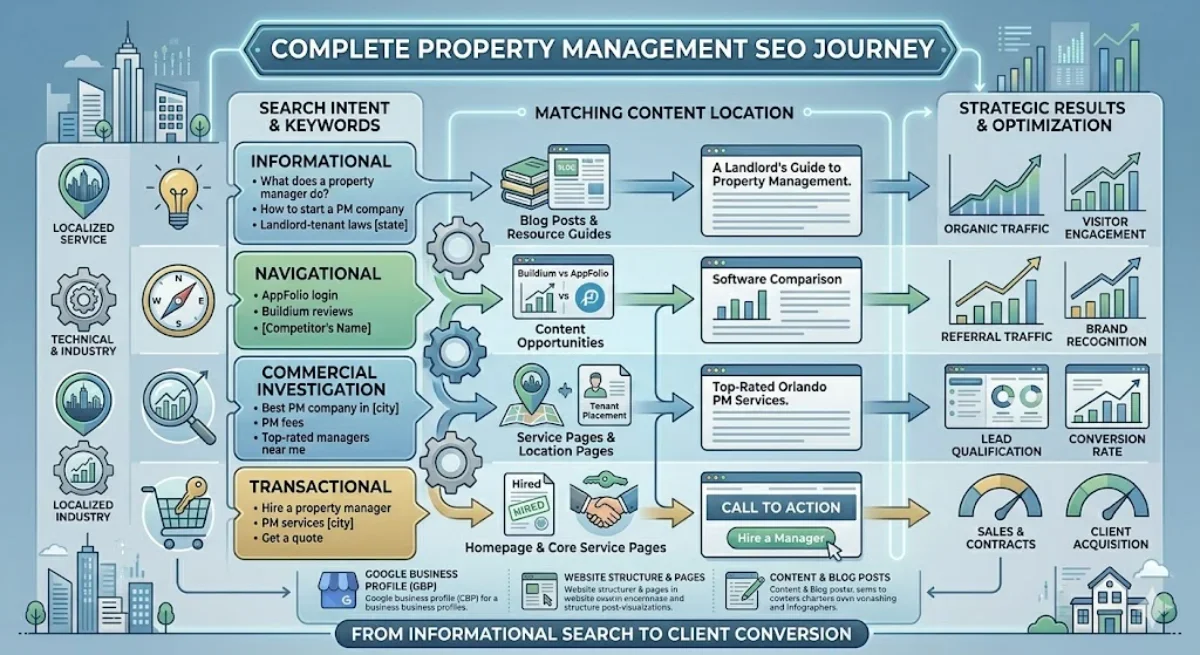
Before we get into the lists, intent matters. Google's job is to match search queries to the most relevant result. If you publish a blog post when someone expects a service page — or vice versa — you won't rank even if your keyword targeting is technically correct. Here's how the four intent types apply to property management:
Informational: The searcher wants to learn. "What does a property manager do?" or "how to start a property management company." These belong in blog posts and resource guides.
Navigational: The searcher is looking for a specific brand or website. "AppFolio login," "Buildium reviews." These are typically bottom-funnel for software companies, not PM firms directly — but they represent content opportunities (software comparison posts, for instance).
Commercial Investigation: The searcher is comparing options before making a decision. "Best property management company in [city]," "property management fees," "top rated property managers near me." These belong on service pages and location pages.
Transactional: The searcher is ready to act. "Hire a property manager," "property management services [city]," "get a quote property management." These belong on your homepage and core service pages — they need strong CTAs.
Category 1: Owner & Landlord Acquisition Keywords
These are the most commercially valuable property management keywords you can target. When a landlord types one of these into Google, they're looking for a company to hand their property to. These belong on your homepage, service pages, and location pages — not buried in blog posts.
Category 1
Owner & Landlord Acquisition Keywords
Pro Tip
Don’t sleep on the pricing and fees cluster. When a landlord searches “average property management fees”, they are doing vendor due diligence and are often close to hiring. A well-optimized pricing page that clearly answers cost questions can convert extremely well.
Category 2: Tenant & Renter Keywords
These keywords won't win you new PM clients directly, but they serve a different goal: filling your owners' vacancies faster. If you manage rental listings and post them on your site, these are the terms prospective renters use to find them. A PM company with strong tenant-side SEO can make "low vacancy rate" part of their owner pitch.
Category 2
Tenant & Renter Keywords
Pro Tip
Don’t treat renter keywords like blog content first. Most of these terms have strong transactional intent, which means your listings page, filtered inventory pages, and tenant portal pages should be optimized to capture demand directly.
Category 3: Property Management Services Keywords
These are service-specific terms — people looking for a specific capability, not just a generic "property management company." Each one below is a candidate for its own dedicated service page, especially if you want to rank for it beyond just your city.
Category 3
Property Management Services Keywords
Pro Tip
If a service is important enough to mention in your navigation or sales pitch, it is usually important enough to earn its own optimized service page. This helps search engines understand your capabilities and gives you a better chance to rank for high-intent, service-specific searches.
Category 4: Property Type Keywords
If your company specializes in a specific asset type, these keywords become priority targets. They're lower volume than generic terms but convert better because the searcher has already self-qualified.
Category 4
Property Type Keywords
Pro Tip
Asset-type keywords may have lower search demand, but they often bring in more qualified leads. A landlord searching for condo property management or student housing management already knows what they need, which makes these terms strong candidates for high-conversion service pages.
Category 5: "How to Start a Property Management Company" Keyword Cluster
This is one of the highest-volume informational clusters in the PM niche — and one of the most underutilized by existing PM companies. "How to start a property management company" gets 1,600 searches per month. The people searching this are either: (a) future PM company owners who will eventually need software, services, and advice, or (b) real estate investors doing due diligence on hiring a PM company vs. self-managing.
Both audiences are worth reaching. Group (b) in particular — investors who researched self-management and decided against it — are some of the warmest owner leads in the market.
Category 5
“How to Start a Property Management Company” Keyword Cluster
Content Strategy Note
State-specific pages work especially well in this cluster because licensing rules, business requirements, and market dynamics vary by state. A repeatable framework like “how to start a property management company in [state]” can turn one strong content model into 10 to 15 separate ranking assets across major markets.
Category 6: Property Management Marketing & SEO Keywords
This category is different from the others, these are the terms that PM company owners search when they're looking for marketing help. Ranking for these terms isn't just about individual pages. It's about building topical authority, the signal Google uses to determine whether your site genuinely covers a subject in depth.
The more comprehensively you cover property management marketing as a topic, the more likely Google is to rank each individual page within it. If you're an agency or consultant targeting PM companies (or a PM company that wants to understand what your marketing firm is doing), these are the keywords that describe the services.
Category 6
Property Management Marketing & SEO Keywords
Strategy Insight
This category is your lead generation engine if you're targeting property management companies. Combine high-level authority blogs (like strategies and guides) with conversion-focused service pages (SEO, PPC, lead generation) to capture demand at every stage of the funnel.
Category 7: Property Management Software Keywords
Software comparison keywords are an underused traffic source for PM companies and agencies alike. The volumes here are significantly higher than most PM service terms. A property management company that publishes an honest, detailed AppFolio or Buildium review can pull in thousands of monthly visits from PM operators evaluating their tech stack — who are, by definition, running a PM business and potentially in market for related services.
Category 7
Property Management Software Keywords
A well-written review or comparison of platforms like AppFolio or Buildium can generate consistent traffic from property managers who are already running businesses and may need marketing, SEO, or operational support.
Opportunity Insight
The keyword “buildium” (40,500/mo) is primarily navigational, but it presents a major opportunity. By publishing a high-quality Buildium review or comparison, you can realistically capture traffic from positions 5–10 in search results — pulling in a meaningful share of users actively evaluating software and running property management businesses.
Category 8: Long-Tail Question Keywords
These are the "People Also Ask" terms — lower individual volume but often very easy to rank for, and they drive featured snippets. One well-structured FAQ section or blog post can capture dozens of these at once.
Beyond standard blue-link rankings, these long-tail questions are your best opportunity to capture SERP features — the featured snippets, People Also Ask boxes, and knowledge panels that appear above organic results. A single FAQ section with direct, concise answers can earn multiple SERP feature placements at once.
Category 8
Long-Tail Question Keywords
Optimization Note
These long-tail questions are ideal for FAQ sections, featured snippet optimization, and supporting blog content. The key is to answer each question directly, use clear subheadings, and structure your content so Google can easily pull concise answers into search results.
Category 9: Local & Geographic Keyword Patterns
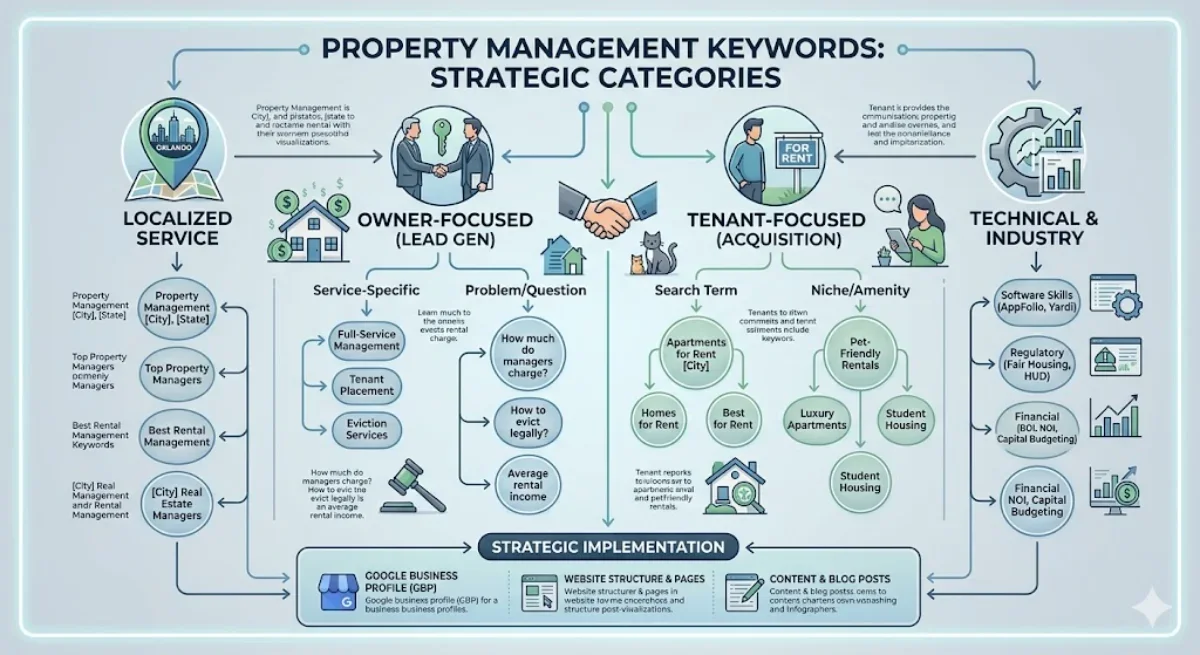
Local keywords are the bread and butter of property management SEO. Unlike national informational content, these terms convert directly. Every major market your company operates in should have a dedicated location page targeting these patterns.
Category 9
Local & Geographic Keyword Patterns
Templates to Implement for Every Market
| Keyword Pattern | How to Use It |
|---|---|
| [City] property management | Highest local volume. Use this in the H1 of your location page. |
| [City] property management company | Usually the second most searched variation. Use it naturally in the opening paragraph. |
| property management [city] | Same intent, different word order. Include it naturally in body copy and image alt text where appropriate. |
| property management companies in [city] | Strong commercial investigation term. Use in subheadings and comparison-style sections. |
| best property management company in [city] | Highly commercial. Best used in reviews, testimonials, awards, and social proof sections. |
| property manager [city] | Less common, but still valid. Include as a natural variation in copy and FAQs. |
| [city] rental property management | A more specific variation that can strengthen topical relevance for owner-focused pages. |
| [neighborhood] property management | Useful for larger metro areas with well-known neighborhoods or districts. |
| [county] property management | Helps capture rural, suburban, and county-level searches that may not use city names. |
| [city] HOA management | Use this if you offer HOA or association management services in that market. |
| [city] vacation rental management | Use this if you offer short-term rental or vacation rental management services. |
Local SEO Note
The strongest local pages do more than swap city names. They combine these keyword patterns with market-specific copy, reviews from that area, local stats, and service relevance so the page feels genuinely built for that market instead of templated.
For companies operating across multiple cities, build a separate page for each market rather than cramming them all onto one page. Google treats each location page as a separate ranking asset. A company with 8 service areas and 8 properly optimized location pages will outrank a company with one page listing all 8 cities.
Category 10: Competitor & Comparison Keywords
These are lower-volume but very high-intent. Someone Googling "[competitor company name] reviews" or "alternatives to [PM software]" is actively in decision mode. If you can show up here — either with a comparison page or a strong Google Business Profile — you're competing at the exact moment a prospect is evaluating options.
Category 10
Competitor & Comparison Keywords
Competitive Search Note
These searches happen at the decision stage. That makes them especially valuable. A strong comparison page, an optimized reviews page, and an actively managed Google Business Profile can help you win visibility right when prospects are comparing options side by side.
How to Use These Property Management Keywords Strategically

Having a keyword list is step one. Knowing where each keyword belongs is step two — and most PM company SEO breaks down here. Here's a simple framework for placing keywords correctly:
Homepage
Your homepage should target your primary transactional keyword — typically "[city] property management" or "property management services [city]." Put the primary keyword in your H1, in the first 100 words of body copy, in your meta title, and in your meta description. Don't try to rank your homepage for informational queries — it almost never works.
Service Pages
Each service you offer (tenant screening, maintenance, accounting, leasing) should have its own dedicated page targeting the relevant service keyword. One page per service, not one long page listing all services. This gives Google a clear signal about what each page is for.
Location Pages
One page per city or market you serve. H1: "[City] Property Management Company." Include localized content — specific neighborhoods, local market data, why you know the market. Thin location pages that just swap city names don't rank.
Blog Content
Use your blog for informational and question keywords — "how to start a property management company," "property management tips," "average property management fees." These build topical authority and bring in traffic that converts over time. Each blog post should target one primary keyword and 2–4 closely related secondary terms.
Rather than targeting one keyword per post in isolation, build your blog around keyword clusters — groups of related terms that support a central topic. For example, "property management fees," "average property management fees," and "how much does property management cost" are three separate keywords that belong in the same cluster. One well-structured post can rank for all three simultaneously.
⚠️ Warning
One Keyword. One Page. No Exceptions.
Assign each keyword to exactly one page — and commit to it. Creating multiple pages targeting the same keyword leads to keyword cannibalization, where your own content competes against itself in search results.
This splits authority, confuses search engines, and ultimately suppresses rankings — preventing any single page from reaching its full potential.
✔️ The Fix: Build a clear keyword map. One primary keyword per page. Support it with internal linking — not duplication.
Google Business Profile
Your GBP description should naturally include "[city] property management," "property management services," and 1–2 service-specific terms. Also use your GBP posts to publish content around local searches and events. Your Q&A section is an opportunity to seed keyword-rich answers to common questions — don't leave it empty.
A strong keyword strategy goes beyond single terms. Cluster related keywords together around a central topic and build content that covers the entire cluster — this is what SEO practitioners call a topical map. When Google crawls your site and sees deep, interconnected coverage of property management keywords across your homepage, service pages, and blog, it builds topical authority for your domain.
That authority is what separates PM companies ranking on page one from those stuck on page three, regardless of backlinks. Avoid keyword cannibalization by assigning one primary keyword per page, with 2–4 semantic variations supporting it. And periodically run a content gap analysis — compare what you rank for against what your top competitors rank for, and identify SERP features you are not yet capturing. That gap is your next 90 days of content.
Frequently Asked Questions
-
The highest-value property management keywords for owner acquisition are "[city] property management," "property management services," "property management companies near me," and "rental property management." These signal active buying intent — someone looking to hire a PM company right now. Pair them with strong service and location pages and you have the foundation of a solid PM SEO strategy.
-
Start with Semrush, Ahrefs, or Google Keyword Planner. Enter your city + "property management" and review the related terms and questions. Then pull the organic keyword report for your top 2–3 local competitors — that shows you exactly what's ranking in your market. Focus on terms with clear commercial intent and reasonable keyword difficulty scores (under 30 is typically achievable for regional PM companies).
-
According to Semrush, "property management keywords" gets approximately 720 searches per month in the US, with a keyword difficulty of 12 out of 100 — making it very achievable to rank for with a well-optimized, comprehensive page.
-
Both, but with different goals. Owner and landlord keywords drive new client acquisition and have high commercial value — these are your priority. Tenant keywords drive rental inquiry volume and help you fill vacancies faster, which is a secondary benefit you can pitch to prospective owner clients. Start with owner keywords. Add tenant keywords once your core service pages are in place.
-
For local keywords in a competitive metro area, expect 3–6 months to see meaningful movement with consistent effort. Less competitive markets move faster. The timeline depends on your current domain authority, how many pages you're optimizing, and your backlink-building pace. Informational blog posts sometimes rank within weeks if they target low-competition queries.
The Bottom Line on Property Management Keywords
Property management SEO isn't complicated — but it is systematic. The companies that win on Google are the ones that have done the keyword research, mapped every keyword to the right page type, and published content that actually answers what people are searching for. The keyword list above gives you the raw material. Execution is what separates it from your competitors' list.
Two priorities for where to start if you're doing this from scratch:
Homepage and location pages first. These are the pages that drive owner leads. Get the primary keywords placed correctly in your H1, meta title, and first paragraph before worrying about anything else.
One high-quality blog post per month on informational terms. Pick the highest-volume question keywords relevant to your market and write thorough answers. These build authority and bring in traffic that gradually converts.
A content gap analysis — comparing what you currently rank for against what your top competitors rank for — will tell you which keywords from this list represent your fastest wins. Gaps where a competitor ranks in positions 1–10 and you rank nowhere are your highest-priority targets.
Need Help Executing This for Your Property Management Company?
ClearLead Digital specializes in SEO for property management companies. We've done the keyword research, we know what's working in this niche, and we build strategies that drive owner leads — not just traffic.
If you want a custom keyword strategy built around your specific markets and service areas, get in touch here or complete the form below. We'll audit what you're ranking for now, identify the gaps, and give you a prioritized plan to close them.
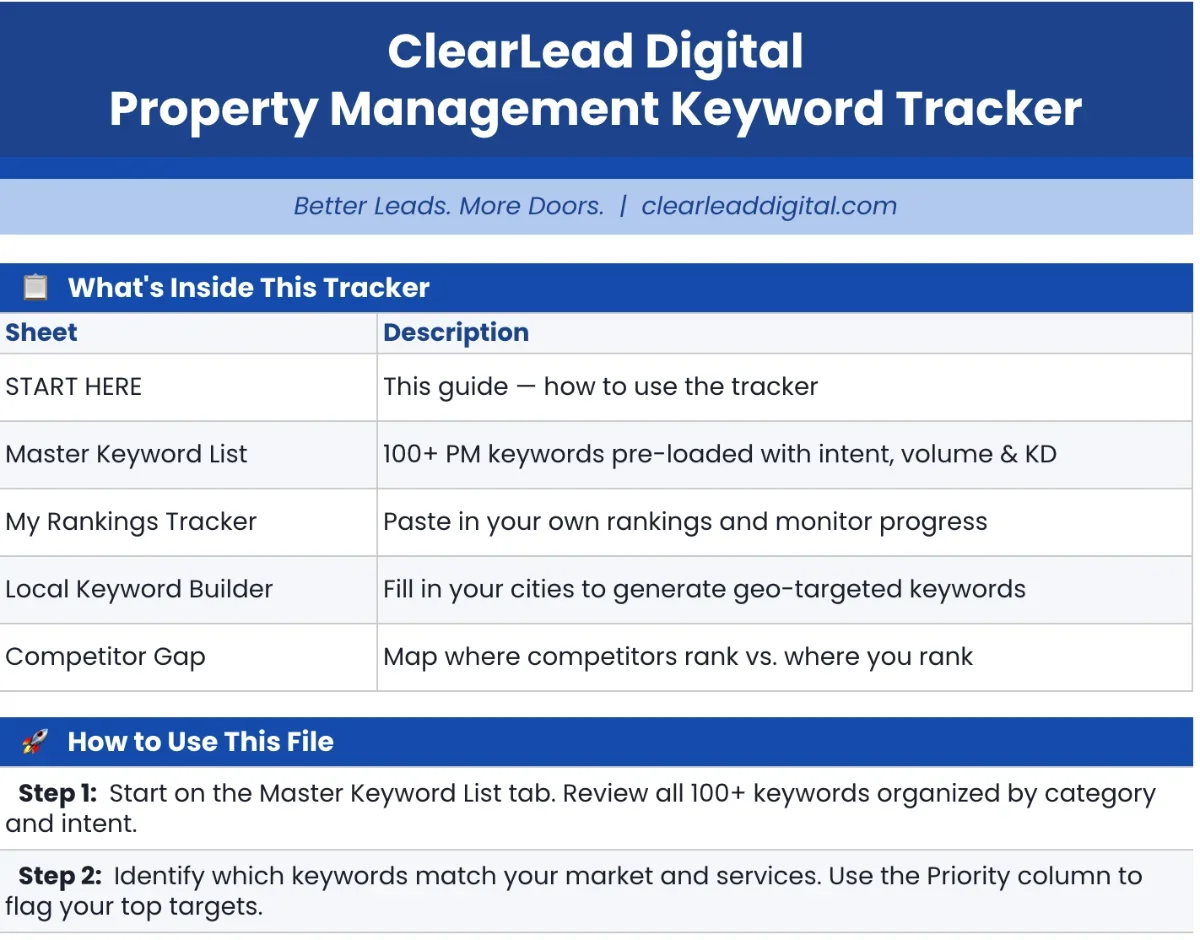
Property Management Keyword Tracker
Download the free Property Management Keyword Tracker — 100+ keywords pre-loaded, 6-month rank tracking, and a local keyword builder for every city you serve.
About This Guide: This keyword list was built using live Semrush data and validated against current SERP results as of Q1 2026. It was written by Alex Zweydoff, a NARPM-designated property management professional (MPM®, RMP®) with direct operational experience managing owner relationships, leasing pipelines, and digital marketing strategy for PM companies. The recommendations here reflect what is actually working in this market right now — not generic SEO advice recycled from an agency that has never managed a door.